Hey, I’m Iro

Working on yourself, in your own words

Tell Iro how your day went — out loud, a couple of minutes. The entry writes itself while you talk. Iro replies, and once a week reads the whole week back to you and suggests what to do next.

  • 7 days free
  • In the browser or the app
  • A written summary every week
  • Tasks built around your week
  • Charts and a mood calendar
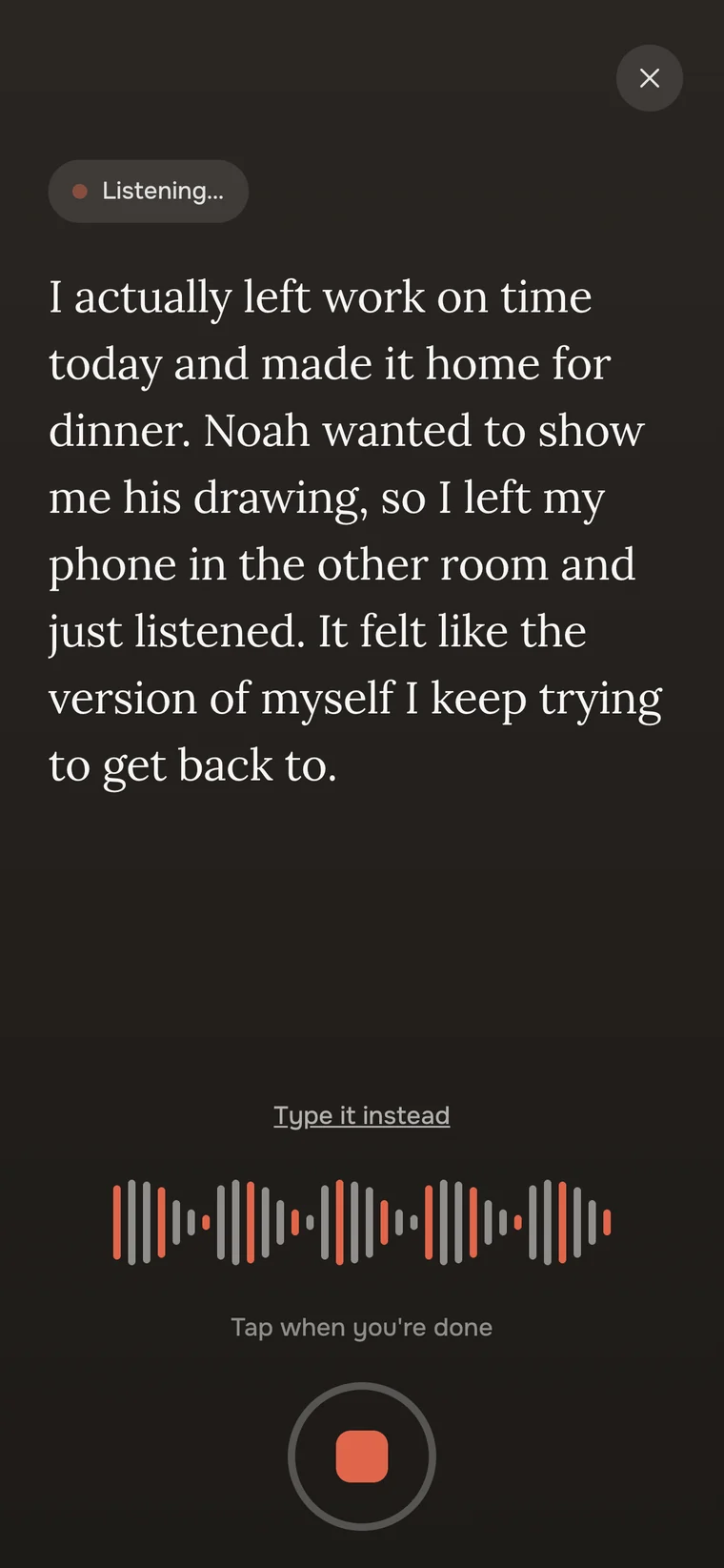
The recording screen: live transcription and a waveform
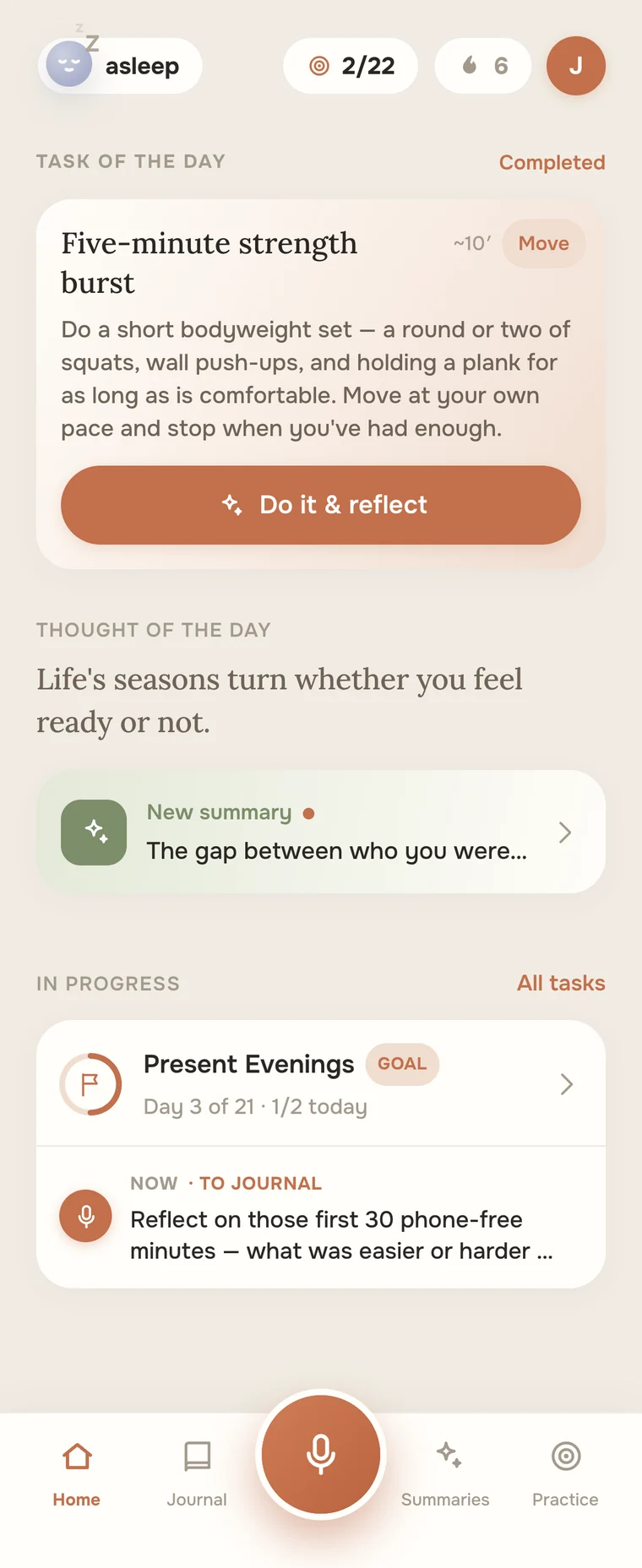
The home screen: the micro-task of the day, the thought of the day and a goal in progress
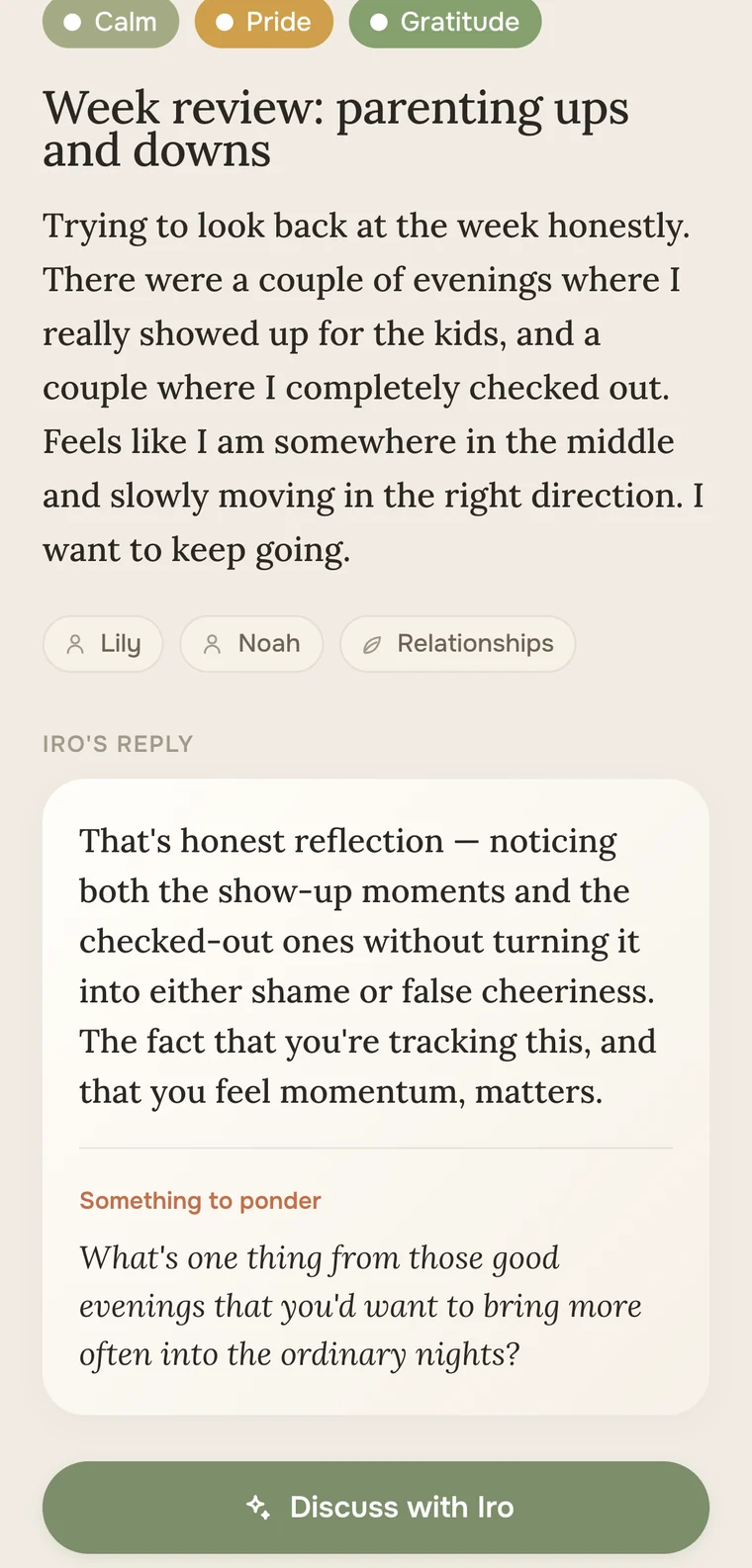
A journal entry with its emotions, the people mentioned and Iro’s reply

Where this starts

Memory is an unreliable witness

By Friday evening the whole week has shrunk to one word: “hard.” What actually made it that way is already out of reach. And “I should do something about this” never quite becomes something you can do at seven on a Tuesday evening.

  • You know the week was heavy; you have no idea where it started
  • The conversation that threw you on Tuesday is gone by Saturday
  • It feels like it has always been this way — though a month ago it wasn’t

How it works

Four steps, and only the first one is yours

You press one big button and talk the way you would to someone close to you. Iro takes it from there: transcribes what you said, replies, and puts the rest in order.

  1. 1

    Talk

    A couple of minutes, in your own words. Rambling is fine. Starting in the middle is fine.

  2. 2

    Iro checks one thing

    A single short question, if something was left unclear. One line, not an interrogation.

  3. 3

    Iro replies

    Two or three sentences, plainly said, and sometimes a question to sit with. Answering is optional.

  4. 4

    The entry is done

    Title, emotions, people, place and topics are already filled in. Any of it changes in one tap.

What Iro picked up

The tagging you never had to do

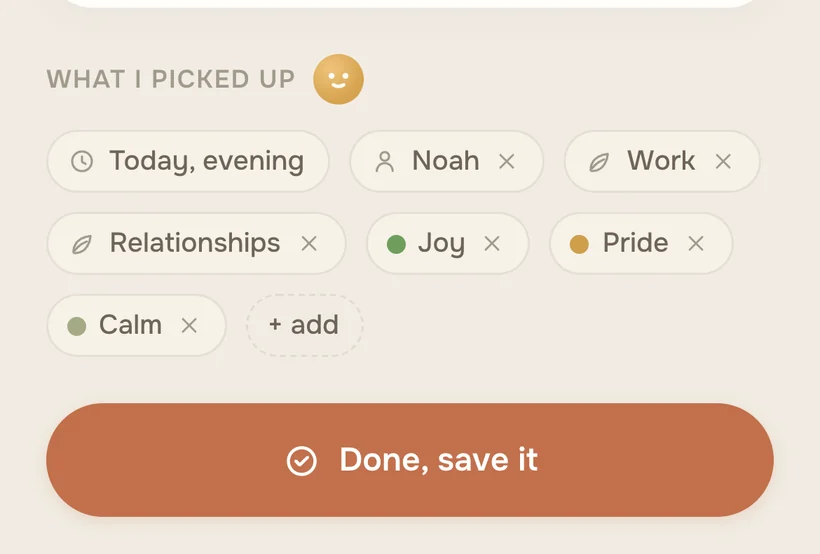
While you were talking, the entry was already being sorted: time, people, topics, feelings. Not tags you owe the app — it is what puts the feelings in some order and makes them easier to understand.

If Iro heard it wrong, any chip comes off with a tap, and editing the text rebuilds the rest around it.

The review screen: chips for time, people, topics and emotions

Voice and reply

One button instead of a blank page

Typing a journal is work, and that is why most of them get abandoned. Talking isn’t: you can stumble, jump around and start in the middle, and Iro will still turn it into something that reads straight. The text appears on screen as you speak.

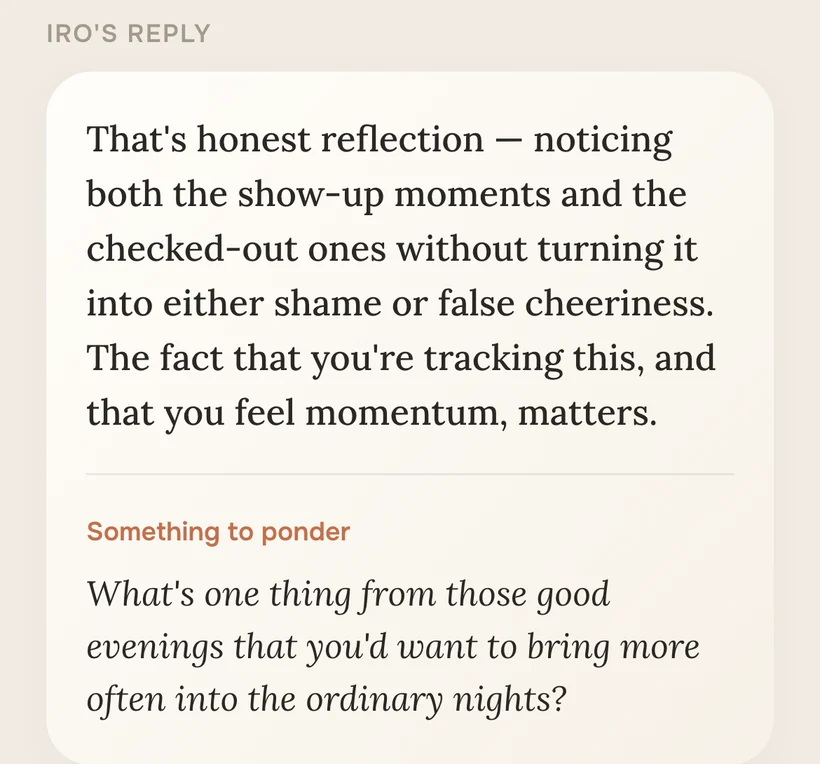
At the end Iro says two or three sentences back — no advice from on high, no verdict on the kind of person you are. Sometimes there is a short practice for right now, or a question worth sitting with.

  • Live transcription while you talk
  • Rambling is fine — Iro will follow
  • Can’t speak right now? The same entry can be typed
  • Nothing is saved until you have seen it and fixed it
The recording screen: a “Listening” badge, live transcription and a waveformIro’s reply to an entry, with a question to sit with

The weekly summary

Once a week, the whole week read back to you

On Sunday Iro rereads the week and writes it up: what got better, what was hard, who was around, which part of the day weighs the most. Not a list of tags — several paragraphs of plain prose, an outside view of a week you were too far inside to see.

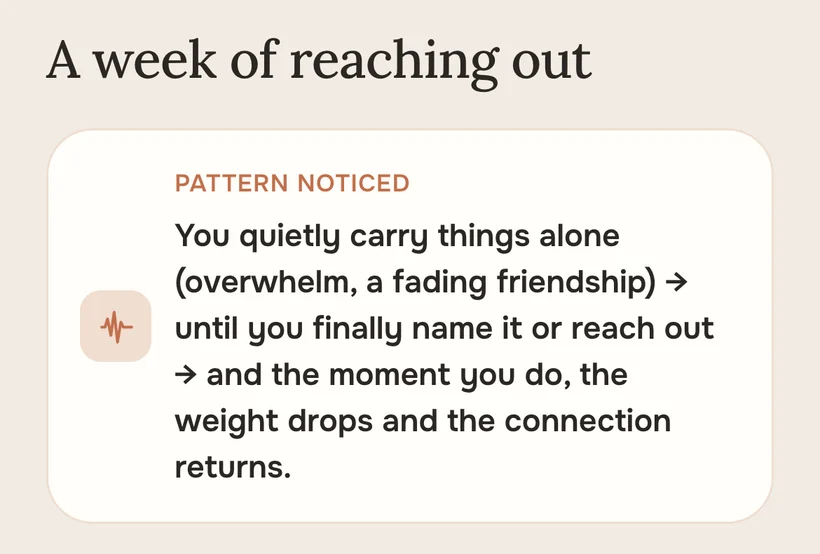
Iro picks out the moments that mattered, and when one thing keeps hooking onto another, names it in words: not “a hard week,” but what exactly, and what it keeps arriving with. Then offers something to do about it.

  • A title for the week and several paragraphs about it
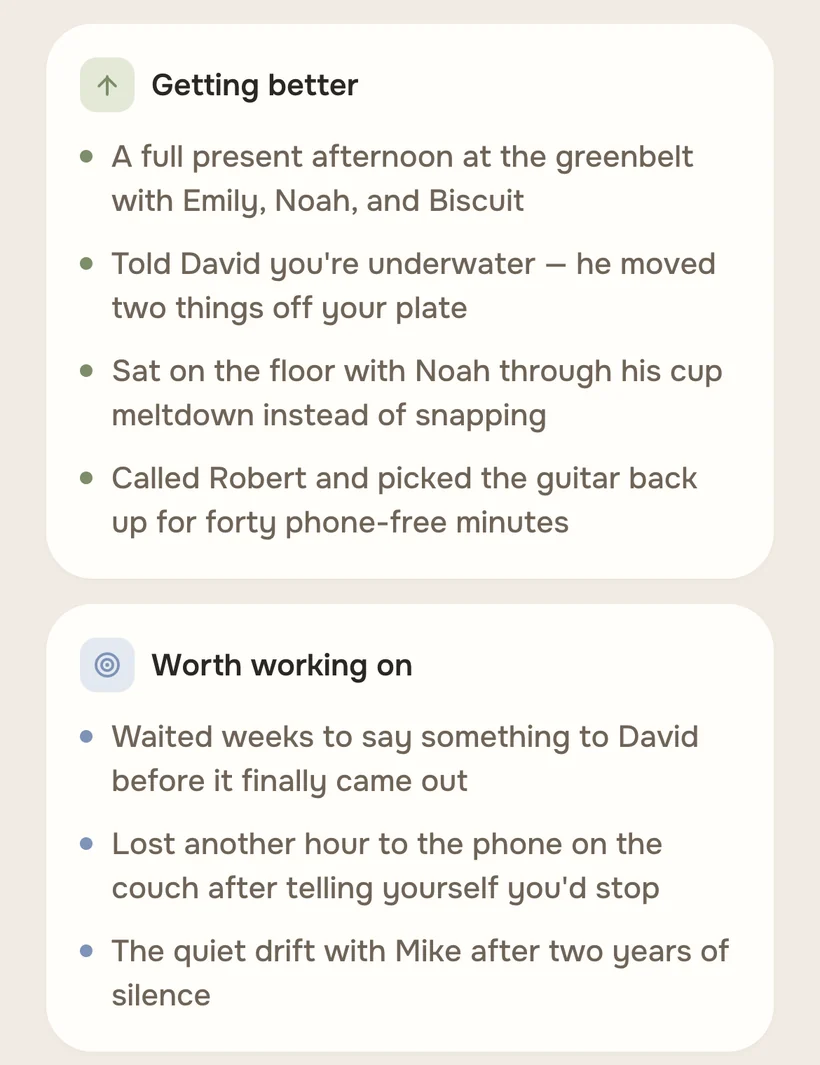
  • “What got better” and “What to work on,” as lists
  • A chart of the week and the time of day that costs you most
  • A repeating pattern, named in words when there is one
  • One step from a summary to a task built out of it
Try it free for 7 days
A “Pattern noticed” card in the weekly summaryThe “What got better” and “What to work on” blocks of a weekly summary

Tasks and goals

Two ways from “I see it” to “I’m on it”

Tasks come from Iro. When the summary shows something dragging on from one week to the next, Iro builds a few days of work around it — usually three or four options to choose from, with one marked as where Iro would start. You don’t have to take any of them.

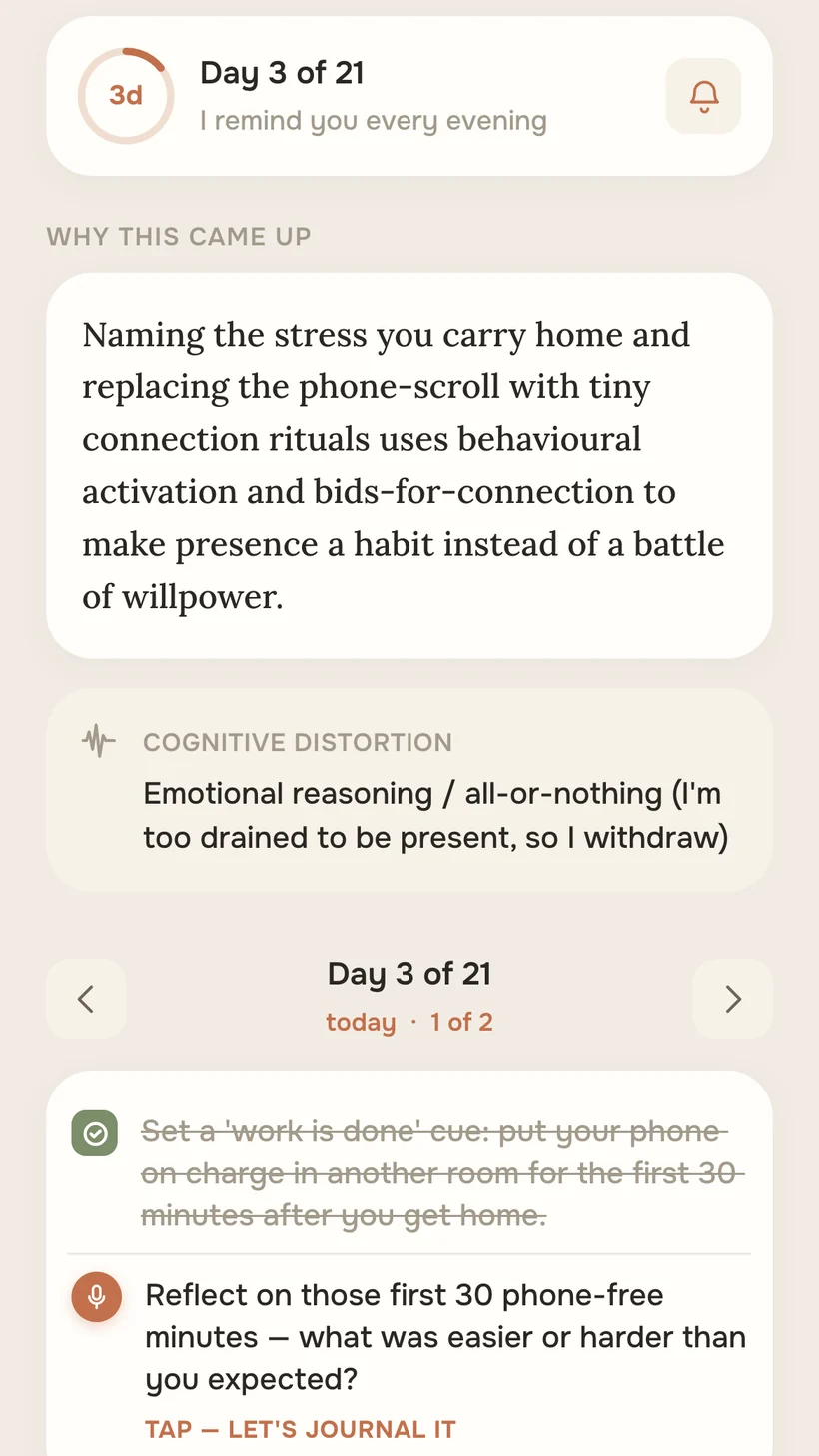
Goals come from you. You state one as a route — here is where I am, here is where I want to be — and Iro writes the way there in short steps: what to do today, what to write about tomorrow. Progress is counted in days, so what you see isn’t “I’m trying” but “day 6 of 14.”

The steps come from methods with a track record: CBT — thought records, behavioral experiments, gradual exposure, behavioral activation; communication techniques for relationships; coaching micro-experiments and if-then plans. Every task says what it is built on.

  • Tasks come out of summaries — Iro proposes, you choose
  • A goal is yours to state: from where you are to where you want to be
  • Steps that take minutes, not “set aside two hours”
  • Iro names the cognitive distortion when one is underneath
  • Some steps are a short entry of their own — spoken or typed
A goal screen: day 3 of 21, the reasoning, and today’s checklistThe micro-task card with its dimension and a “Do it and tell Iro” button

Subscription

The first week is free, and complete

Everything is open during the trial week. No stripped-down demo: you are trying exactly what you would be paying for. If you don’t subscribe, nothing closes — it narrows, and everything you have written stays with you.

The free plan compared with full access
Free $0 after the trial week Full access−33% $10 / mo $120 billed annually, or $15 month to month
Entries a day Free3, text only Full accessAs many as you like, spoken or typed
A reply from Iro on every entry FreeYes Full accessYes
Voice input Free Full accessLive transcription while you talk
Weekly summary FreeShort: the chart and what got better Full accessThe full write-up: several paragraphs, people, time of day
Tasks built out of summaries FreeYes Full accessYes
Goals with a day-by-day plan FreeYes Full accessYes
Micro-task of the day FreeYes Full accessYes
Journal, calendar, the people around you FreeYes Full accessYes
Chat with Iro Free Full accessFrom any entry, task or summary

Free

$0after the trial week

  • Entries a day — 3, text only
  • A reply from Iro on every entry
  • Voice input
  • Weekly summary — short: the chart and what got better
  • Tasks built out of summaries
  • Goals with a day-by-day plan
  • Micro-task of the day
  • Journal, calendar, the people around you
  • Chat with Iro
−33%

Full access

$10 / mo$120 billed annually, or $15 month to month

  • Entries a day — as many as you like, spoken or typed
  • A reply from Iro on every entry
  • Voice input — live transcription while you talk
  • Weekly summary — the full write-up: several paragraphs, people, time of day
  • Tasks built out of summaries
  • Goals with a day-by-day plan
  • Micro-task of the day
  • Journal, calendar, the people around you
  • Chat with Iro — from any entry, task or summary
Try it free for 7 days

No card to start: signing up asks for an email address and nothing else.

What else is in there

The parts you notice in week two

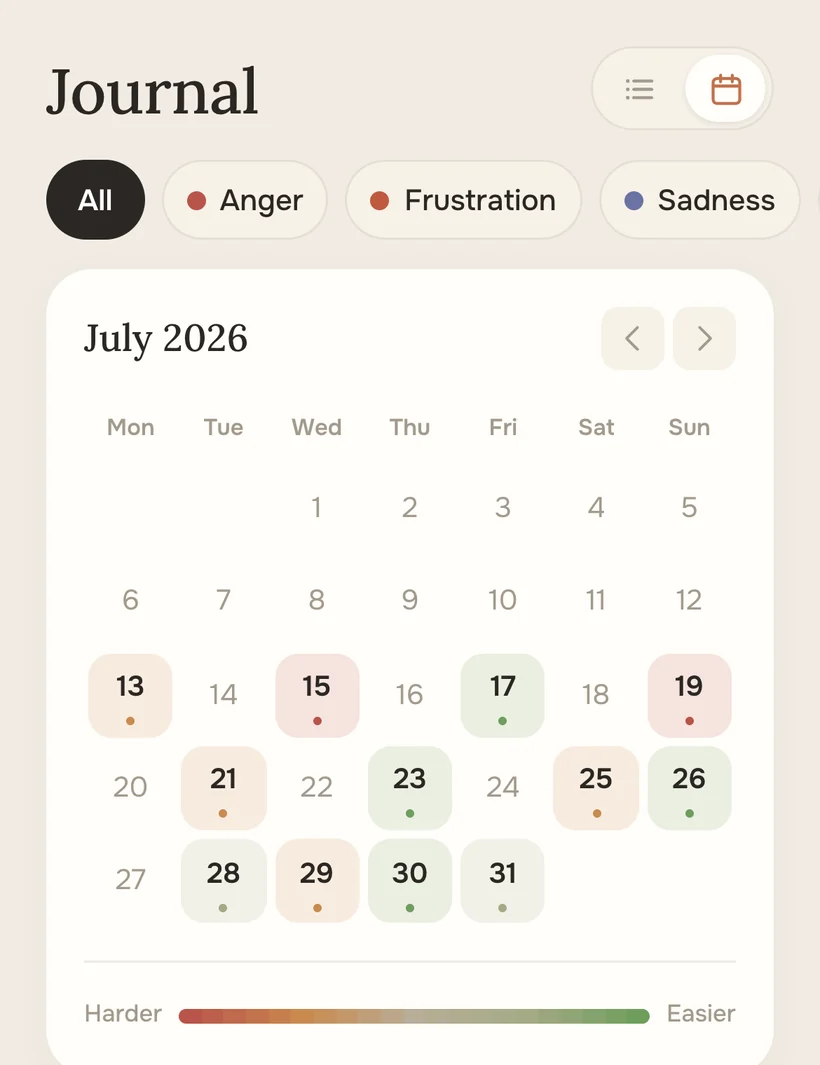
A month calendar with every day tinted by its average mood

The journal and the mood calendar

Entries gather by day, and in the calendar each day is tinted by its average mood — warm patches and cold streaks show up at a glance. Filter by emotion and “it was hard all month” turns out to have been Tuesday and Thursday.

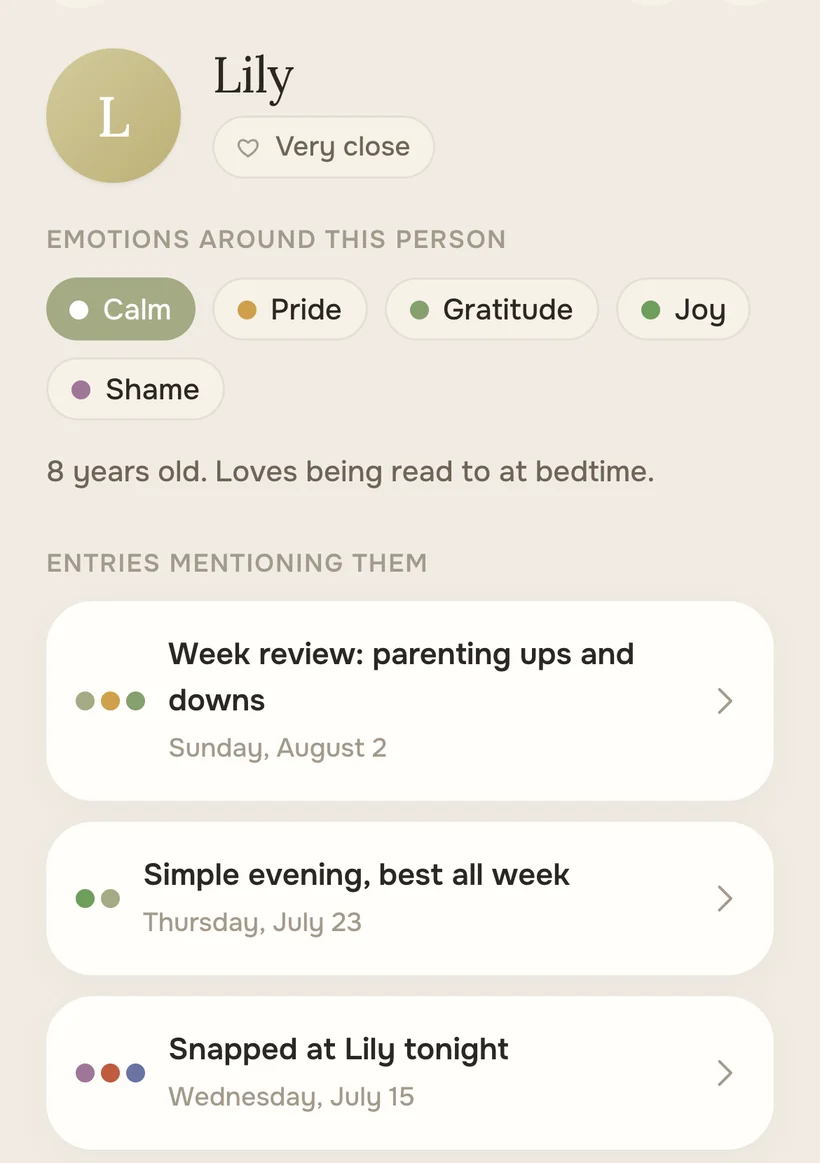
A contact card: the emotions that show up around this person and the entries they appear in

Who you feel better around

The people you mention become contacts on their own — there is no list to keep. Each one builds up an emotional profile: which feelings tend to show up when they do. Pets count, deliberately.

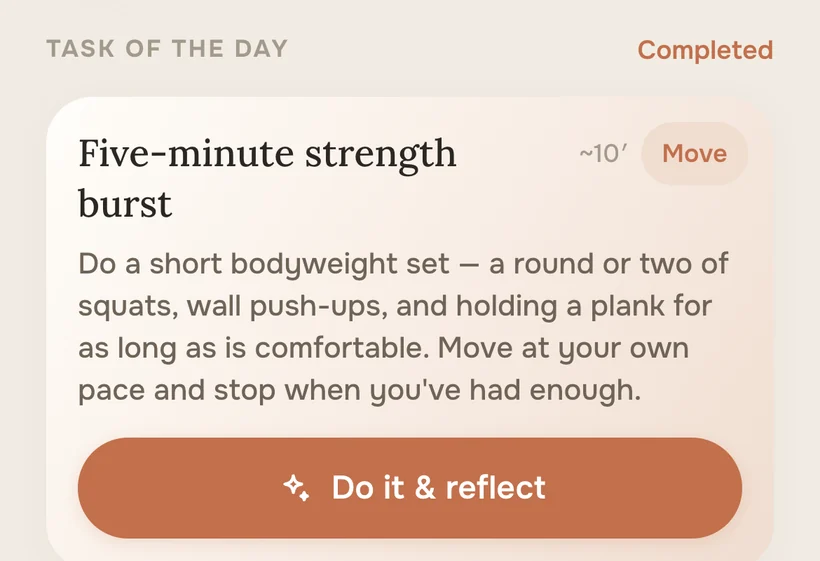
The micro-task card with its dimension and a “Do it and tell Iro” button

The micro-task of the day

One small thing a day, built around your week rather than pulled off a ready-made list. It comes from one of eight wellbeing dimensions: connect, kindness, move, notice, learn, meaning, self-care, courage. Usually a few minutes.

Privacy

Closed even to a glance over your shoulder

Only you can read your entries. Access is enforced row by row inside the database itself, so another account cannot reach them — that is how the storage is built, not a setting anyone can flip.

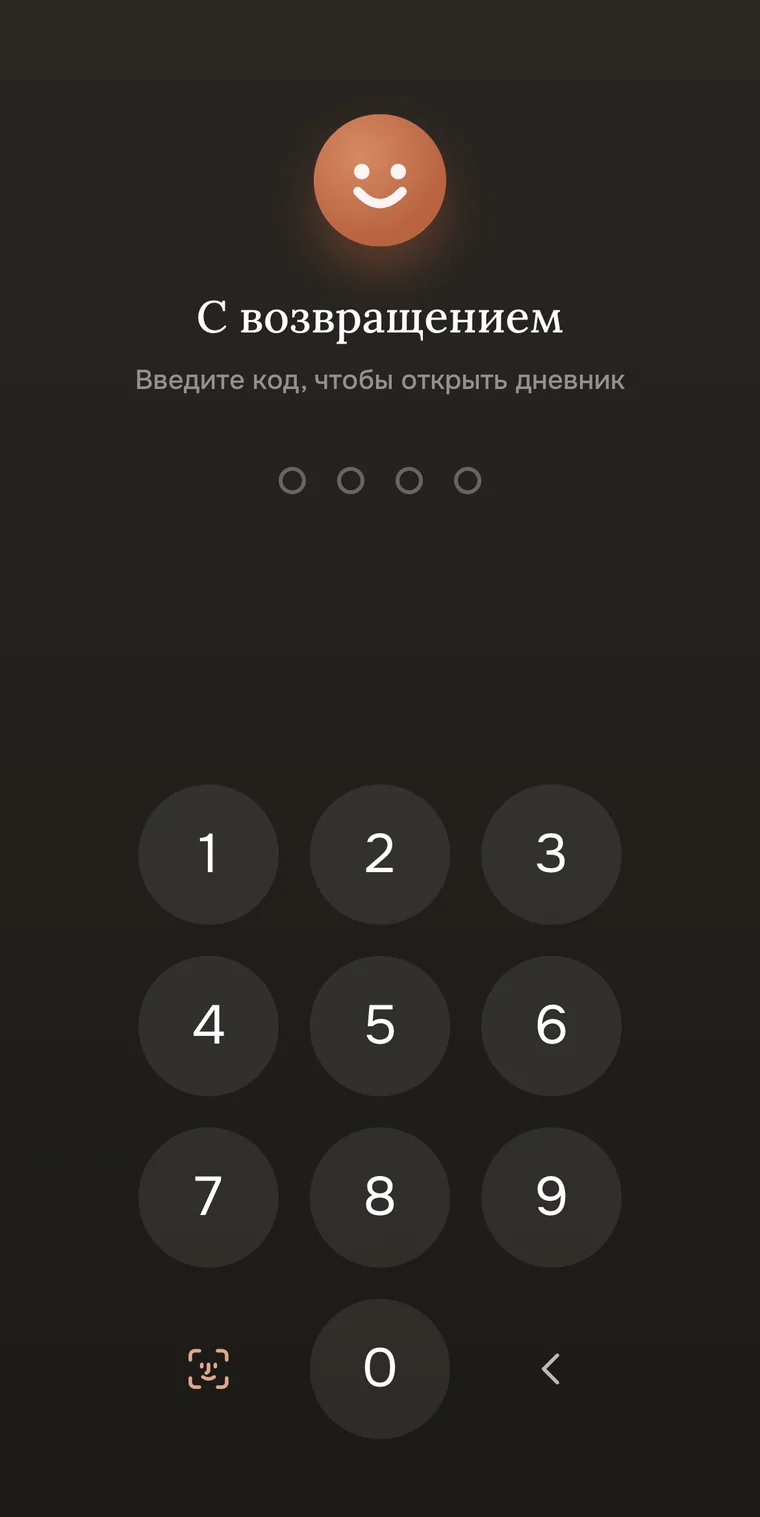
You can lock the app behind a four-digit passcode; in the iPhone and Android apps, a fingerprint or Face ID sits on top of it. We do not sell your data, and we pass it only to the services Iro cannot work without: speech recognition and the language model.

  • A passcode on the way in — switched on in settings
  • Row-level access control in the database itself
  • The account and every entry in it are deleted on one screen, with no email to support
The lock screen with its four-digit passcode

Questions

What people usually ask

Is this therapy?

No. HeyIro is an emotion journal and a tool for paying attention to yourself. It does not diagnose, it does not treat, and it does not replace a therapist or a doctor. If things are heavy enough to be getting in the way of your life, it is worth seeing a professional — the two go together, and plenty of people use both. For adults, 18+.

Who can see my entries?

Only you. Access is enforced at the level of the database itself, so your entries are technically out of reach from any other account, and you can lock the app with a four-digit passcode (in the iPhone and Android apps a fingerprint or Face ID sits on top of it). We do not sell your data, and we pass it only to the services Iro cannot work without — speech recognition and the language model.

Do I need a card to start?

No. Signing up asks for an email address and nothing else; no payment details. When the trial week ends the choice is yours: subscribe, or carry on with the free plan.

What happens after the free week?

Nothing disappears: your entries, goals and summaries stay with you either way. You can subscribe — $10 a month billed annually, or $15 month to month. Or you can stay on the free plan: three text entries a day, each with a real reply from Iro, and a short weekly summary. Voice input and chat with Iro are not part of the free plan.

Does it work on iPhone and Android?

Yes. It is one and the same app everywhere: open app.heyiro.com in a browser on your computer or your phone, or install the mobile app. One account, and entries sync across all of it.

Do I have to speak out loud?

No. Any entry can be typed — Iro will pull out the emotions, people and topics just the same, and reply just the same. Voice is simply faster: two minutes of talking against ten of typing, and talking comes out easier than composing sentences. The free plan is text only.

I skip days. Have I ruined it?

No. Nothing resets and nothing goes back to zero — you pick up on the day you stopped, and the summary is written from the entries that exist. We will remind you about the journal, but we will not scold you for it: this is here to help with anxiety, stress and the knots you tie yourself into, not to add guilt about an app to the pile.

How many entries before patterns show up?

The first summary arrives this coming Sunday, built from whatever days exist by then. The calendar in color and the profiles of the people around you get genuinely interesting after two or three weeks, once there is enough there to compare against.

How much time does this take a day?

Usually two to ten minutes: one spoken entry and one small task of the day. The tasks are deliberately doable — the point is that they happen, not that they look impressive. Once a week the summary adds about five minutes.

How is this different from a mood tracker?

A tracker shows you that Thursday was bad. A journal keeps why. Iro takes the step after that: it reads the whole week, notices what repeats, and builds it into tasks for specific days. The journal here is not the destination — it is the material.

How is this different from talking to an ordinary AI?

A chat ends and leaves nothing behind. Here every entry goes into one picture: a month in the calendar, the weekly write-ups, the emotional profiles of the people around you, a plan counted in days. And Iro works from that history instead of starting from a blank page every time.

Are there limits on the paid plan?

Only technical ones, against abuse: about twenty minutes of dictation a day and a daily ceiling on how much work the language model does. Normal use never touches them — they are there to stop automated load, not to sell you something else.

Where to start

Start with one evening — tonight

No need to gather your strength, finish the book first or wait for Monday. Say how your day went: two minutes out loud. In a week you will have your first summary; in a month, a calendar in color and a fairly clear sense of what keeps coming back around.

  • The first week free, all of it
  • In the browser or the app

HeyIro is an emotion journal and a tool for self-observation. It is not therapy and not medical care: Iro does not diagnose, does not prescribe treatment and does not replace a professional. If things are severe or have gone on a long time, it is worth seeing a doctor or a therapist — and if you are in crisis right now, contact your local emergency services. For adults, 18+.